Quickmart’s IPO meets a consumer who is coping, not recovering
In the month Quickmart announced its IPO, prices hit a 2½-year high and shoppers' spending confidence sat near its yearly low.
Quickmart announced its IPO on 23 September, the same month Kenya’s annual inflation reached 6.8%, its highest since January 2024. Kasi Insight’s data points to a challenging consumer backdrop: household budgets are holding, but confidence in spending and the wider economy remains weak.
September’s Discretionary Spending Index stood at -25.7, close to its 12-month low of -27.2. Consumers are managing their budgets, but a sustained recovery in their willingness to spend remains elusive.
Household budgets are holding. Economic confidence is not.
Households appear better able to manage today’s budgets than to feel confident about tomorrow’s earnings. Stronger budget sentiment does not necessarily mean rising disposable income or greater capacity to invest.
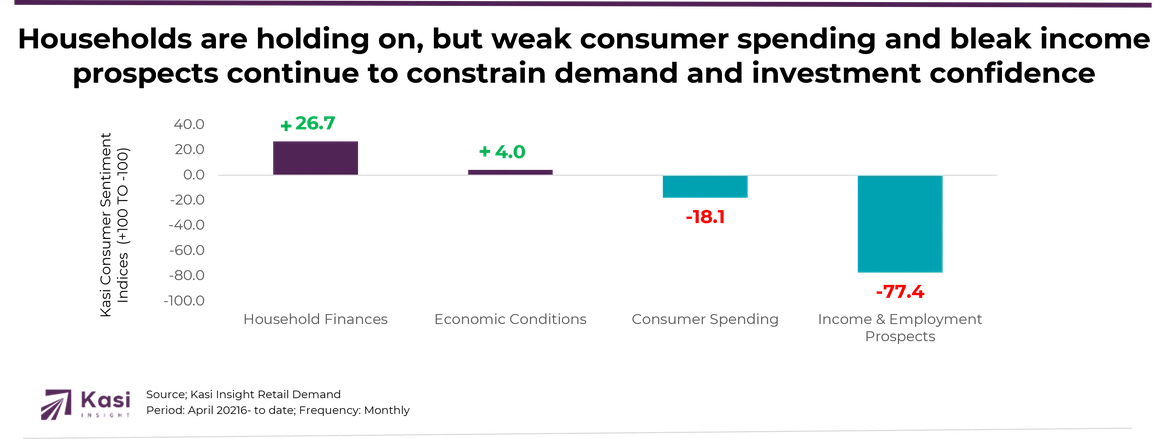
Overall consumer sentiment averaged -6.7 over the 12 months to September 2026, unchanged from the preceding year. Beneath that stability, household and economic perceptions are moving apart. The Household Budget Index averaged 29.2, up 5.6 points year on year, with July’s 36.0 the highest since late 2021. Meanwhile, perceptions of the city and national economies each fell by approximately 6 points. Job Prospects (-75) and Money Making (-73) remain deeply negative.
The mid-year rebound has reversed
Discretionary Spending improved to -7.3 in June before falling to -25.7 in September. Current Conditions deteriorated from -40.1 to -52.3 over the same period. That reversal makes June’s improvement a temporary spike, not yet a recovery. The timing coincided with higher food and fuel prices, but the data cannot establish causation.
Household budgets holding up alongside deeply negative earnings expectations is consistent with consumers adjusting spending to fit their means. Expectations remain positive at +10, while the Central Bank of Kenya forecasts 5% economic growth in 2026 and identifies El Niño as a key risk. But growth in the economy does not automatically translate into greater household financial comfort.
What this means for investors and businesses
For prospective Quickmart investors, affordability matters more than optimism alone. In Q3 2026, Kasi RDI shows a 21-point gap between Loans and investment showing borrowing demand running well ahead of investment demand, although the index cannot establish why households are borrowing.
Quickmart’s KSh 3,750 minimum application lowers the entry barrier but does not guarantee participation. The offer involves existing shares, so Quickmart receives no proceeds. Uptake by the 30 October closing date will provide a useful, though limited, read on retail investor participation.
For retailers and other businesses, Premium and discretionary categories should look for sustained improvement in spending and current conditions before treating June’s rebound as a new baseline.
Watch food prices, El Niño-related risks, job prospects and the widening gap between household budgets and economic confidence.
Consumers are holding their budgets together, but confidence in their financial future remains weak. The opportunity is there; evidence of a sustained spending recovery is not.